
OUR IMPACT
For medically complex babies, care coordination isn't a nice-to-have. It's the difference between 86% survival and 76%.
And that's just the beginning.
PROGRAM SCALE
Real children.
Real families.
Real outcomes.
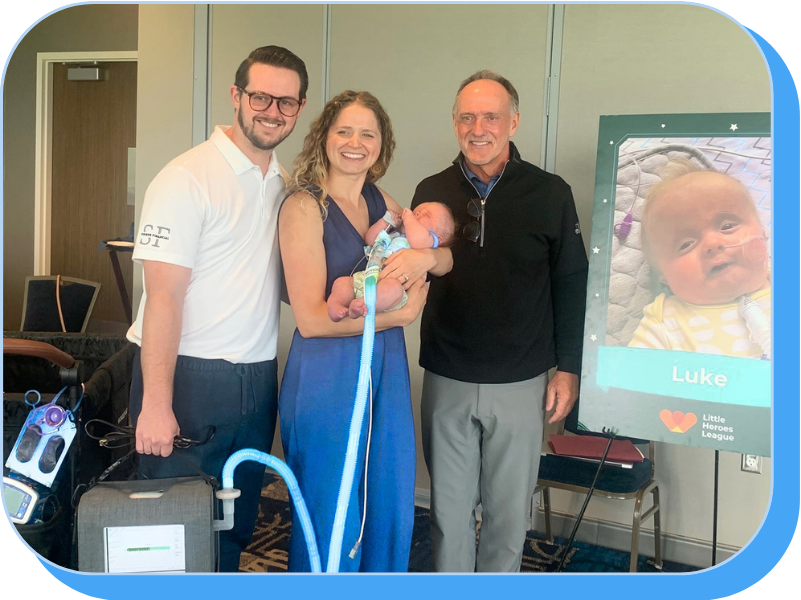
Behind every number is a medically complex baby who deserved — and received — a dedicated coordinator by their side.
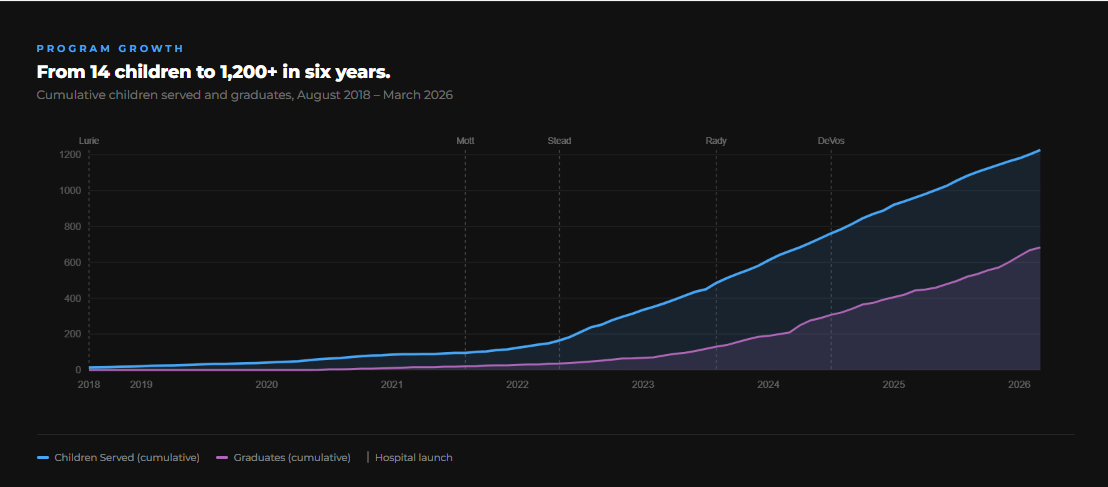
1,200+
CHILDREN SERVED
Medically complex infants enrolled in LHL care coordination programs across five top-ranked Level IV NICUs since 2018.
500+
PROGRAM GRADUATES
Families who completed the program — meaning their child reached a healthier, more stable place and they have the skills to navigate complex care independently.
MEASURED PROGRAM OUTCOMES
Care coordination changes lives - in measurable ways.
Independent research and program data show meaningful improvements for medically complex babies and the families who care for them.
-
86% <em>vs 76%</em>
Two-year survival
86% 2-year survivability — compared to 76% without our program. In plain terms: our coordinators are helping babies live who otherwise might not.1
-
0%
Lost to follow-up
Zero families lost to follow-up in peer-reviewed study — when medically complex babies disappear from care, the consequences can be devastating. Our coordinators make sure that never happens.
-
23
Specialist appointments completed
Median completed specialist appointments per patient in the first 3 months home — on top of medications, equipment, insurance, and sleepless nights.1
-
96%
Parents empowered
Of parents felt empowered to advocate for their child — families who arrived overwhelmed and left confident.2
-
70%
Families facing significant barriers
Of enrolled families face significant barriers to navigating care — families who, without a dedicated coordinator, may not make it through.1
-
5
Leading hospital partners
Top-ranked Level IV NICUs that have independently adopted and institutionalized the LHL model.

"These are at-risk families that would not make it, I believe, without a coordinator."
— Neonatologist, Lurie Children's Hospital

THE EVIDENCE
Peer-reviewed research confirms the impact.
Two peer-reviewed studies have evaluated Little Heroes League's neonatal care coordination program—demonstrating improved outcomes for medically complex infants and increased confidence among the families who care for them.
PEDIATRICS OPEN SCIENCE - 2025
Longitudinal Care Coordination Improves Survival and Eliminates Loss to Follow-Up
KEY FINDINGS
86% two-year survival compared with 76% in historical controls
0% of enrolled families were lost to follow-up
Successfully enrolled infants with greater medical complexity and significant social needs
Demonstrated that the model is transferable to other Level IV NICUs
-
The program also identified increasingly complex patients over time while reducing odds of prolonged hospitalization.
Voller S, Dizon MLV, Matoba N, Ryan AA, Mestan KK. Pediatrics Open Science. 2025;1(2):1–11. doi:10.1542/pedsos.2024-000228
ADVANCES IN NEONATAL CARE - 2023
Families and Providers Rate LHL Coordination as Highly Effective
KEY FINDINGS
Parents reported frequent communication and personalized support
Families developed confidence advocating for their child's needs
Providers reported improved communication and continuity of care
Identified the model as transferable to other NICUs while emphasizing the importance of maintaining small care coordinator caseloads
-
Voller S, Dizon MLV, Matoba N, Ryan AA, Mestan KK. Pediatrics Open Science. 2025;1(2):1–11. doi:10.1542/pedsos.2024-000228
FAMILY EMPOWERMENT
The goal isn't just better outcomes.
It's empowered families.
Our coordinators don't just manage care — they build the skills and confidence families need to advocate for their children long after graduation.

96%
of parents enrolled in LHL felt comfortable advocating for their child's needs in the NICU — a population that typically arrives feeling overwhelmed and voiceless. 2

"Little Heroes League is everything to me.
I have a go-to person who totally knows us and can anticipate our needs. They think of questions I didn't even know I had. They support me, advocate for me, and show me I can do this. We wouldn't be here without Little Heroes League."
— LHL Parent
"We can't change your medical situation...
But what we can do is figure out ways to empower you and give you the skills to be successful."
— LHL Care Coordinator
A FAMILY’S STORY
Charlotte’s Story
Charlotte was born with multiple complex medical needs requiring an extended NICU stay at Lurie Children's Hospital. Like many families, her parents suddenly found themselves coordinating specialists, equipment, medications, therapies, and an uncertain future.
Their Little Heroes League care coordinator became the one constant throughout the journey—connecting providers, attending appointments, anticipating challenges, and helping Charlotte's parents grow from overwhelmed caregivers into confident advocates.
Today, Charlotte is home - and thriving.
HEALTHCARE SYSTEM RECOGNITION
When the evidence is strong enough,
systems take notice.
LHL's model has moved from philanthropically-funded innovation to healthcare system recognition — a trajectory that validates the model and amplifies the impact of every donor dollar.
Michigan Medicaid Recognition
Michigan Medicaid now partially reimburses this model, recognizing the value of neonatal care coordination and helping expand access for more families.
Every Partner Hospital Has Renewed
All five hospital partners have renewed their commitment to Little Heroes League—some as many as four consecutive times.
When hospitals choose to continue investing year after year, it reflects sustained confidence in the model and the value it delivers.
Why Donors Still Matter
Donor support isn't a bridge to somewhere else.
It's the foundation that makes everything possible — in Michigan and every state where LHL operates. Medicaid partial reimbursement helps sustain what donors built. Every new hospital, every new state, and every family served starts with philanthropic investment. That will always be true.

Be a BIG Hero to a Little Hero.
Your support funds a model that is peer-reviewed, backed by science, and changing lives from the earliest days.
SOURCES
Voller S, Dizon MLV, Matoba N, Ryan AA, Mestan KK. Impact of Longitudinal Care Coordination on Medically Complex Infant Outcomes in a Level IV Neonatal Intensive Care Unit. Pediatrics Open Science. 2025;1(2):1–11. doi:10.1542/pedsos.2024-000228
Dallas A, Ryan A, Mestan K, Helner K, Foster C. Family and Provider Experiences With Longitudinal Care Coordination for Infants With Medical Complexity. Advances in Neonatal Care. 2023;23(1):40–50. doi:10.1097/ANC.0000000000000998
Clark S, Cohn L. Impact of the Partners for Children Pilot Program on Medicaid Utilization and Expenditures. Susan B. Meister Child Health Evaluation and Research (CHEAR) Center, University of Michigan. June 2020. Delivered to Michigan Department of Health and Human Services.
Vance AJ et al. Neonatal Care Coordination Multi-Site Longitudinal Cohort Study. NIH R01 Application, 2025. Participating sites: Lurie Children's Hospital, C.S. Mott Children's Hospital, Rady Children's Hospital, Helen DeVos Children's Hospital.